Who is responsible for the sewer and water line between your house and the street
Written for Calgary homeowners · Last reviewed August 15, 2026
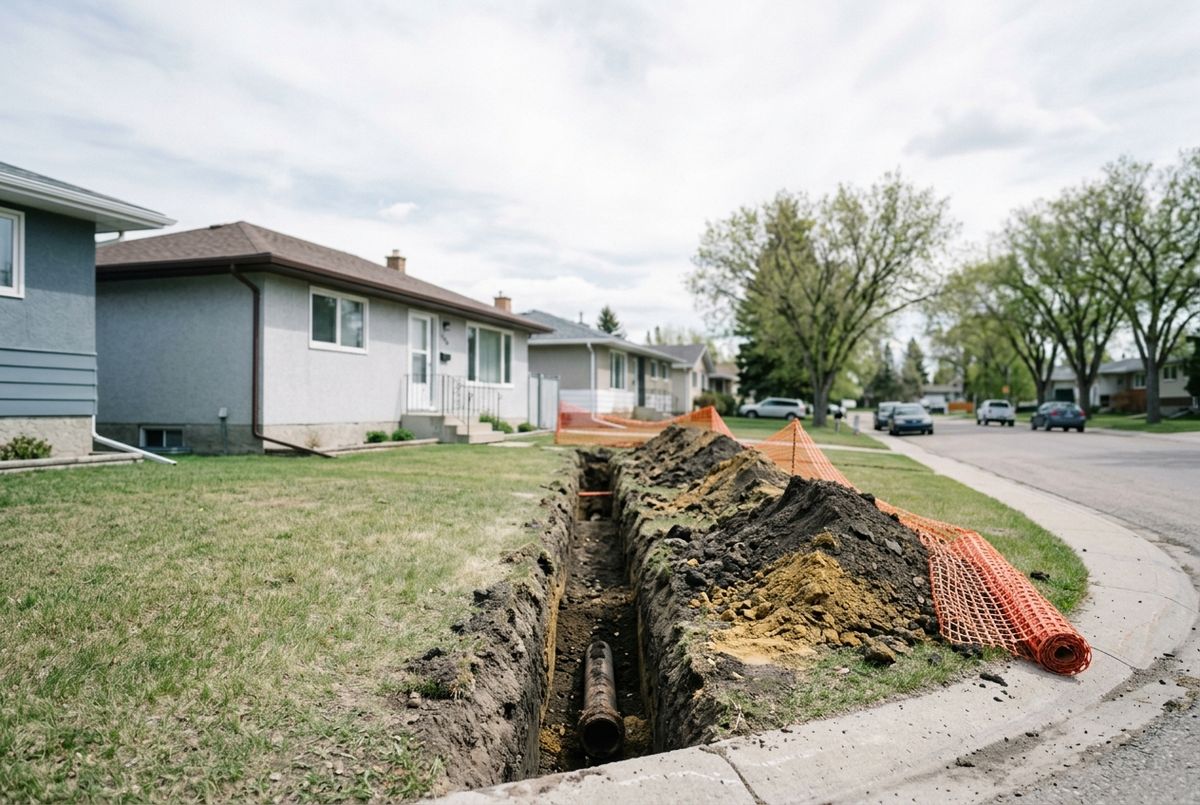
Most people read this page on the worst possible day — the day a plumber hands them a quote with five figures on it and says the words "it's on your side." Here's what determines whether that's true.
Short answer: The City of Calgary owns the water and sewer service pipes from the mains under the street up to your property line. You own everything from the property line into your house, and you pay all repair costs on that private-side portion — the water meter is the single exception. Because the property line typically sits only a few metres in from the edge of the curb or sidewalk, a failure that looks like it's "out by the road" is very often still yours.
Sources: The City of Calgary — Water service lines and Water and sewer connections. As of August 2026.
Almost every page you'll find on this question is either written for Toronto or written by a plumbing company that never links a City of Calgary source. The rule here is specific, it's published, and it applies to both pipes — the water line coming in and the sewer line going out. Most competing pages only talk about the sewer, which is how people get blindsided by the other half.
Picture the geometry, because it's the whole argument
Stand on your front step and look toward the street. Under that ground there are two separate pipes running from your house out to the road, and they belong to different people at different points along their length.
- Inside your basement wall. Your water service enters through the foundation, usually on the street-facing side, and the first thing it hits is your main shut-off valve and then the water meter. Your sewer leaves through the foundation on roughly the same side, often with a cleanout — a capped access point — near where it exits.
- Under your front yard. Both pipes run out under your lawn, driveway or front garden. Every metre of this is yours: yours to maintain, yours to repair, yours to pay for.
- The property line. This is the boundary of the parcel you actually own. It is not the curb and it is not the sidewalk. In most Calgary neighbourhoods it lands a few metres back from the edge of the curb or sidewalk, which means the strip of grass you mow between your sidewalk and the road — the boulevard — is frequently City land while the pipe under part of it is still on your side of the line.
- Past the property line. From there out to the water main and the sanitary sewer main under the street, the pipe is The City's responsibility.
The practical version: your ownership does not stop at your fence, your hedge, or your sidewalk. It stops at a surveyed line that you cannot see from the street.
How to find your actual property line
Don't estimate it. The document you want is your Real Property Report — the legal survey most Calgary homeowners received when they bought, often filed with the mortgage paperwork. It shows the parcel boundary with dimensions from the house. If you can't find yours, an Alberta Land Surveyor can produce one, and your lawyer's file from the purchase may already have a copy.
Then get the defect located by distance. A camera inspection reports depth and distance from the cleanout — "root mass at 11.5 metres." Put that against the survey dimension to the front property line and the ownership question answers itself instead of coming down to whose guess sounds more confident.
Don't let anyone settle this verbally. If a contractor tells you a defect is on your side, ask for the camera footage and the distance reading in writing. If they tell you it's The City's side, that's a 311 call, not a repair. Either way the number matters more than the opinion.
The curb stop is The City's to operate, not yours
Somewhere near your property line there's a small round metal cap set into the lawn or the sidewalk. That's the access to your water service valve, usually called the curb stop — the shut-off for the water feeding your house from the main. It sits very close to the property line, and it is not always on The City's side of it, but The City owns it: "Service valves are owned and operated by The City of Calgary." To have yours turned off or on, you book a service call through 311.
Sources: The City of Calgary — Service valves in Calgary; The City of Calgary — Water service lines in Calgary. Note that neither source says a homeowner or plumber is legally barred from operating the valve — what they say is that The City owns and operates it, which is the reason to leave it alone.
That means if your job needs the water shut off at the street — a service line replacement, a meter issue, a failed main shut-off inside the house that won't hold — the shut-off gets arranged through The City rather than done by whoever's in your driveway. Build that into your timeline, the same way you would for any sewer or water line repair that reaches the boulevard. A crew that shows up expecting to work and then has to wait on a valve turn has just cost you a day.
It also means your inside shut-off is the one that saves you in an emergency. Find it before you need it. In most Calgary homes it's in the basement near the water heater on the street-facing wall, and knowing where that handle is turns a flooded basement into a wet floor. Our main plumbing guide covers the five-minute version of that check.
What to do in the first hour when sewage appears in your basement
This is the sequence that limits the damage and protects your position afterward.
- Stop using water immediately. No flushing, no laundry, no dishwasher, no showers — and tell everyone in the house. If the line out is blocked, every litre you send down is looking for the lowest opening in your basement, which is the floor drain you're standing next to.
- Get people and belongings out of it. Sewage is a health hazard, not just a mess. Boxes off the floor, kids and pets out of the room, and don't wade through it in bare feet or run a shop vac you care about.
- Photograph everything before you clean. Wide shots of the room, close shots of the water line on the wall, the drain itself, and every damaged item. This is what your insurance claim is built on, and you only get one chance to take these.
- Call 311. Ahead of calling a plumber. The agent works through whether this looks like internal plumbing or possibly City infrastructure, and dispatches accordingly. If several homes on your block are backing up at once, say so — that pattern points at the main, not at you.
- Call your insurer. Ask specifically whether you have sewer backup coverage and what they need from you. Most policies have notification expectations and you don't want to discover yours late.
- Then call a plumber. If 311 determines the blockage is on private property, that's your call to make, and it should include a camera pass — not just an auger. Clearing the blockage without finding out why it happened means you're doing this again. What a proper drain cleaning involves covers the difference.
What City crews will and won't do
Worth knowing before they arrive so you're not expecting the wrong thing. The City states plainly that crews will not move furniture, pull back carpet, remove toilets or make holes in drywall to identify the source of a backup. Their job is to determine whether City infrastructure is involved. If the blockage is on private property, you're advised to call a plumber.
Source: The City of Calgary — Sewage backup
Two things we deliberately won't tell you, because we can't verify them and other sites state them as fact: whether The City charges anything when 311 dispatches a crew and the problem turns out to be private-side, and whether there's a formal compensation or damage-claim process when a City-side failure floods your basement. Ask 311 both questions directly while you have them on the phone — they're exactly the sort of thing worth having a clear answer on, and we'd rather send you to the source than guess on your behalf.
The water line has its own rule: 15 days
The sewer gets all the attention, but the water service line is the one with a deadline attached. Under the Water Utility Bylaw, an owner must repair a confirmed service line leak within 15 days, or The City may issue a remedial order. That's a genuinely short window once you factor in getting quotes, booking a crew and scheduling a shut-off at the street.
Source: The City of Calgary — Water service line leaks
A leaking service line is also silently expensive while you decide what to do about it. Water you never used still runs through your meter, and Calgary bills water and wastewater volume together. If your bill has jumped and nobody can find the cause inside the house, the buried line is a real candidate — how to check your meter for a silent leak walks through the test.
Three ways it gets repaired
| Method | What actually happens | When it tends to make sense |
|---|---|---|
| Trenchless service pull | A new line is drawn through or alongside the old path from small pits at each end, so your yard, driveway and mature trees mostly survive the job | A straight run in reasonable soil where the whole line is due for replacement anyway |
| Open excavation | The line is dug up along its length and replaced in the open, which costs you the surface above it but gives full access and a visual inspection of everything | Collapses, awkward routing, or where the pipe has to be seen to be believed |
| Hydrovac spot repair | Pressurised water and vacuum expose one small area precisely, so a single defect can be fixed without trenching the whole run | One known, located failure point — not a line that's failing generally |
The reason to ask which method a contractor is quoting is that the cheapest line item isn't always the cheapest outcome. A spot repair on a pipe with three more weak joints in it is a down payment on the next dig, and a trenchless pull that saves a 40-year-old spruce has value that doesn't show up on the invoice.
What you can do before anything goes wrong
- Locate your Real Property Report now. Ten minutes in a filing cabinet today saves an argument on the worst day.
- Know your line's likely material. Pre-1970 inner-city Calgary generally means clay tile sewer and possibly galvanized water supply. Both have predictable failure modes, which makes budgeting a plan instead of a shock. What your Calgary home's pipes are made of walks through identifying them — and explains why the City's public pipe map answers a different question than the one most people ask of it.
- Camera the sewer once if the house is old and you've never seen it. A single inspection tells you whether replacement is a five-year question or a twenty-year one.
- Fit backflow protection if your basement is finished. Owning the pipe doesn't mean you can stop a surcharged main coming back at you — a backwater valve does, and a plumbing permit is required to install one.
- Ask your broker about a service line endorsement. Base policies commonly don't cover the buried pipe itself; that's the add-on that addresses roots, corrosion and shifting earth.
Got a quote and want to know whether the pipe is even yours?
Send us the camera footage or the distance reading and we'll tell you honestly what it points at — including when the answer is "call 311, this one isn't yours to pay for." No charge for that conversation and no booking attached to it.
Questions Calgary homeowners actually ask
Sewage is coming up in my basement floor drain right now. Who do I call first?
311, before you call anyone else — including us. It costs you nothing, it takes a few minutes, and it's the only way to find out whether the problem is in the City's main or in your line. If the main is surcharged, half the block is backing up and a plumber augering your pipe accomplishes nothing.
While you're waiting, stop using water anywhere in the house. Every flush, every load of laundry, every shower is more volume heading for the lowest opening in your basement. Get anything you care about off the floor, keep kids and pets out of the room, and take photos before you clean anything up — your insurer will want them and so will anyone you end up arguing with about who pays.
The blockage is out near the sidewalk. Isn't that the City's?
Probably not, and this is the single most expensive misunderstanding in Calgary. The property line usually sits only a few metres in from the curb or sidewalk — not at the curb itself. So a break under your boulevard grass, two metres short of the road, can still be squarely on your side of the line and entirely your bill.
The way to settle it rather than guess is to pull your Real Property Report or your legal survey and look at where the front property line is drawn, then have the line camera'd so the blockage gets located by distance from the cleanout. Once you have "the defect is at 11 metres" and "the property line is at 9 metres," the argument is over and you know who's paying.
Can my plumber just shut off the valve at the curb so we can work?
Not on their own, no. That curb stop — the little metal cap in your lawn or sidewalk near the property line — belongs to The City, which says plainly that "service valves are owned and operated by The City of Calgary." Having one turned off or on is a service call you book through 311, not something the van in your driveway arranges.
So if a job needs the water off at the street, that booking goes into the schedule and you plan around it. Inside your house the main shut-off is yours, and you should know where it is right now — usually in the basement near the water heater, on the wall facing the street.
I got a letter saying I have a leak on my water service line. How long do I have?
Fifteen days, once the leak is confirmed. Under the Water Utility Bylaw an owner has to repair a confirmed service line leak within that window, and The City can issue a remedial order if it isn't done. That's a short runway for booking a contractor and possibly a dig, so start making calls the day the letter arrives rather than the week it expires.
Get two written quotes if you can, and ask each one which method they're proposing — a trenchless pull, a full excavation, or a hydrovac spot repair on a single defect. The prices are very different and so is the damage to your yard. Fifteen days is enough time to get a second opinion; it isn't enough time to think about it for a fortnight first.
My house is from the 1950s. Is my sewer line likely to be a problem?
It's the classic profile, yes. Inner-city Calgary homes built before roughly 1970 typically have clay tile sewer lines with mortared joints, and clay tile plus a mature elm or poplar on the boulevard is the most reliable root-intrusion combination in the city. Cast iron from the same era rots from the bottom of the pipe upward, so it can look fine on a camera pass until it doesn't.
None of that means you have a failure today. It means the sensible move is to know the condition rather than wait to find out at 11 p.m. A camera inspection on a house of that vintage tells you whether you're budgeting for a replacement in five years or in twenty, which is a much better position than discovering it with a wet basement.
Does my home insurance cover a collapsed sewer line?
Usually not the pipe itself under a base policy. An Alberta brokerage writing on this points out that the add-on you actually need is a service line endorsement, which is the coverage aimed at tree roots, corrosion and shifting earth on the buried line — and that things treated as maintenance, like slow clogs, are likely not covered at all. Water damage inside the house and sewer backup coverage are separate items again.
Read your own policy rather than trusting any summary, including this one, and phone your broker to ask two specific questions: do I have a service line endorsement, and do I have sewer backup coverage. On a Calgary house with an original clay line, those two answers are worth knowing before you need them, not after.